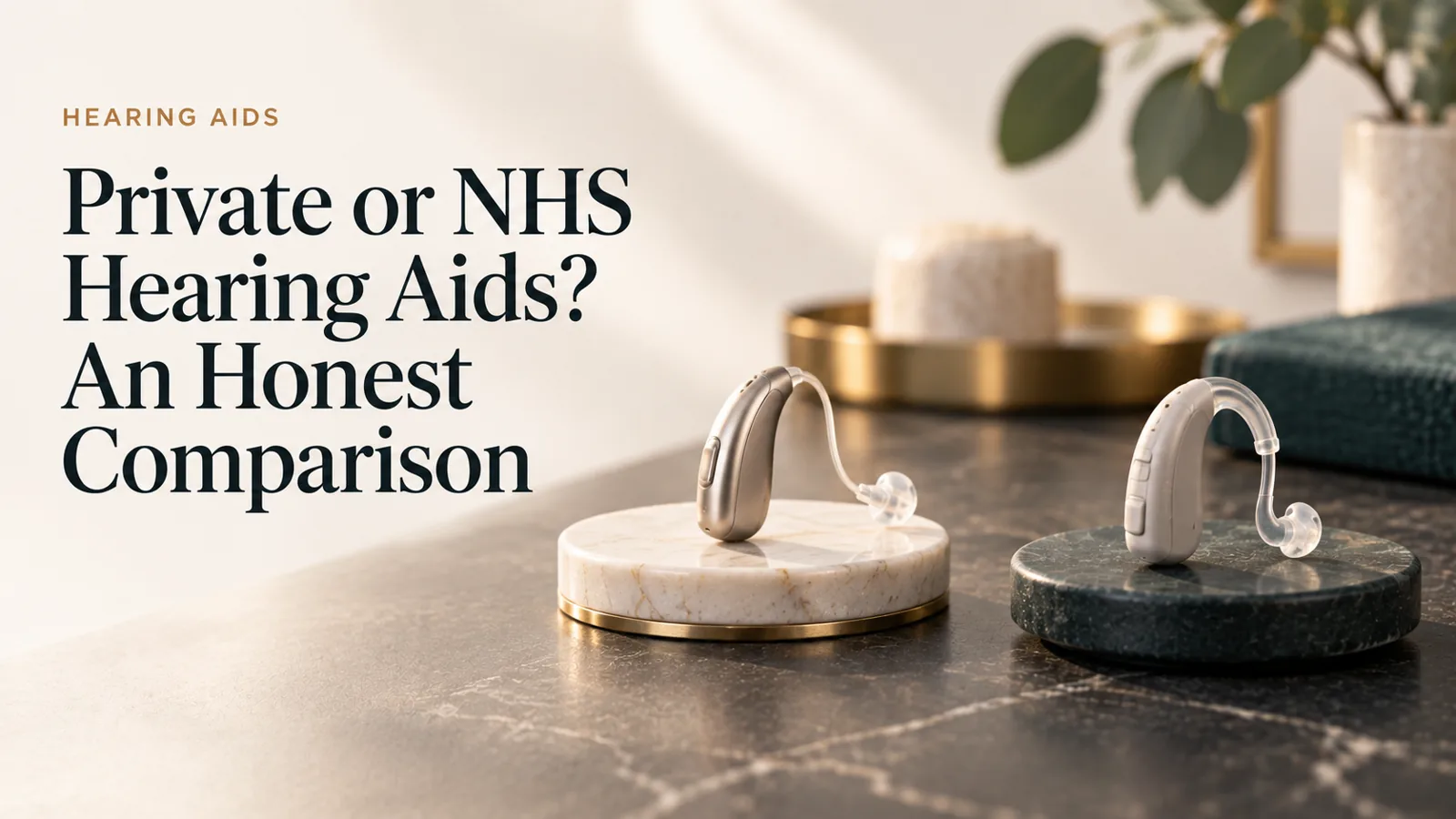

If you've decided it's time to do something about your hearing, one of the first questions tends to be about how to get help: through the NHS, or privately. It's a fair question, and there's no catch in the answer. Both routes are good, and for a lot of people either would work perfectly well.
We're an independent clinic in Wickersley, so we only fit hearing aids privately. But we'd rather you chose the right route for you than feel pushed towards ours. Here's an honest look at what each one offers.
What do NHS hearing aids offer?
NHS hearing aids are free, and that includes the aids themselves, your batteries, and any repairs or replacements down the line. You're referred by your GP to a local audiology department, they test your hearing, and if aids would help they're fitted and set up for you. It's a genuinely good service, and the aids are modern digital devices, not the whistling beige things some people still picture.
A few honest points to set expectations:
- NHS aids are provided on loan. They stay the property of the NHS, so if you stop using them you're asked to return them.
- The choice of styles is more limited. Most NHS aids are behind-the-ear models, which are reliable and easy to handle, but you generally won't be offered the smaller in-the-ear or "invisible" fittings.
- Waiting times vary from area to area, both for the first appointment and for follow-ups if something needs adjusting.
If cost is the deciding factor, the NHS route is a sensible place to start, and there's no shame in that whatsoever.
What's different about private hearing aids?
Going private mainly buys you three things: choice, time, and technology.
Because we're independent, we fit all seven of the leading manufacturers - Widex, Phonak, Signia, Starkey, Oticon, ReSound and Unitron - rather than being tied to one. That matters, because the "best" hearing aid is simply the one that suits your ears, your hearing loss and your lifestyle, and no single brand wins for everyone. You can read more about the options on our hearing aids page.
You'll also usually get:
- A wider range of styles, including discreet in-the-ear and rechargeable models.
- The latest technology, such as improved background-noise handling and direct streaming to your phone or television.
- Longer appointments and more fine-tuning, so the settings can be shaped closely around how and where you actually struggle.
- Ongoing aftercare with the same familiar faces, rather than starting from scratch each time.
None of that makes private aids "better" in every case. It makes them more flexible. For someone with a straightforward hearing loss who's happy with a behind-the-ear fitting, the NHS may give a very similar result.
Which route is right for me?
Honestly, it depends on what matters most to you. A few things worth weighing up:
- Budget. If free care is the priority, start with the NHS.
- Style and discretion. If a smaller or in-the-ear fitting matters to you, that's more likely privately.
- Lifestyle. Busy, noisy environments, lots of meetings, music and phone calls are where the newer technology and finer tuning tend to earn their keep.
- Aftercare. If you like the idea of one local place that knows you and can see you quickly, that's the private strength.
If you're not sure whether you even need aids yet, that's fine too. Sometimes a simple online hearing check shows your hearing is fine, or that the issue is something as ordinary as wax, which we can often sort with microsuction. You might not need us yet, and we'll tell you so.
Do I have to choose one or the other?
Not at all. Plenty of people use both over time. Some start on the NHS and later come to us for a smaller style or newer technology. Others have private aids for everyday life and keep an NHS pair as a spare. There's no rule that says once you've gone one way you can't change your mind.
If you'd like to see what going private actually involves before committing to anything, our first visit page walks you through exactly what happens, step by step. There's no obligation, and no hard sell. We'll give you a straight answer about what would genuinely help.
One important note: if your hearing has dropped suddenly, especially in just one ear, don't wait to compare routes. Sudden hearing loss should be treated as a medical emergency - contact your GP the same day, call NHS 111, or go to A&E, as hearing tends to recover best when it's treated within a few days.
Whichever route you're leaning towards, a clear picture of your hearing is the best starting point. Book a hearing assessment with our Wickersley team, or call us on 01709 437250 for a friendly chat first.