

Walk into any conversation about hearing aids and you'll soon hit a wall of initials: BTE, RIC, ITE, CIC. It can feel like a code everyone expects you to know already. You don't need to. The "style" of a hearing aid simply means where it sits on or in your ear, and each shape carries trade-offs that make it a better or worse fit for a particular person.
This is a plain guide to the main styles, what each does well, and who tends to suit which. There is no single best style, only the one that suits your ears, your hearing and the way you live.
What actually decides which style suits you?
Before we get to the shapes, it helps to know what an audiologist is weighing up. A few things matter more than looks:
- The degree of your hearing loss. More significant losses need more power, which usually means a slightly larger aid.
- The shape and size of your ear canal. Some canals comfortably take a tiny in-ear aid; others don't.
- Dexterity and eyesight. Small aids and small batteries can be fiddly if your fingers or vision aren't what they were.
- Your lifestyle. Busy social calendar, phone streaming, wind and weather, glasses and face coverings all nudge the decision.
None of this is guesswork. It comes out of a proper online hearing check and an honest chat about your day-to-day. If you're still weighing up whether you even need aids yet, our overview of hearing aids is a good place to start.
What is a behind-the-ear (BTE) hearing aid?
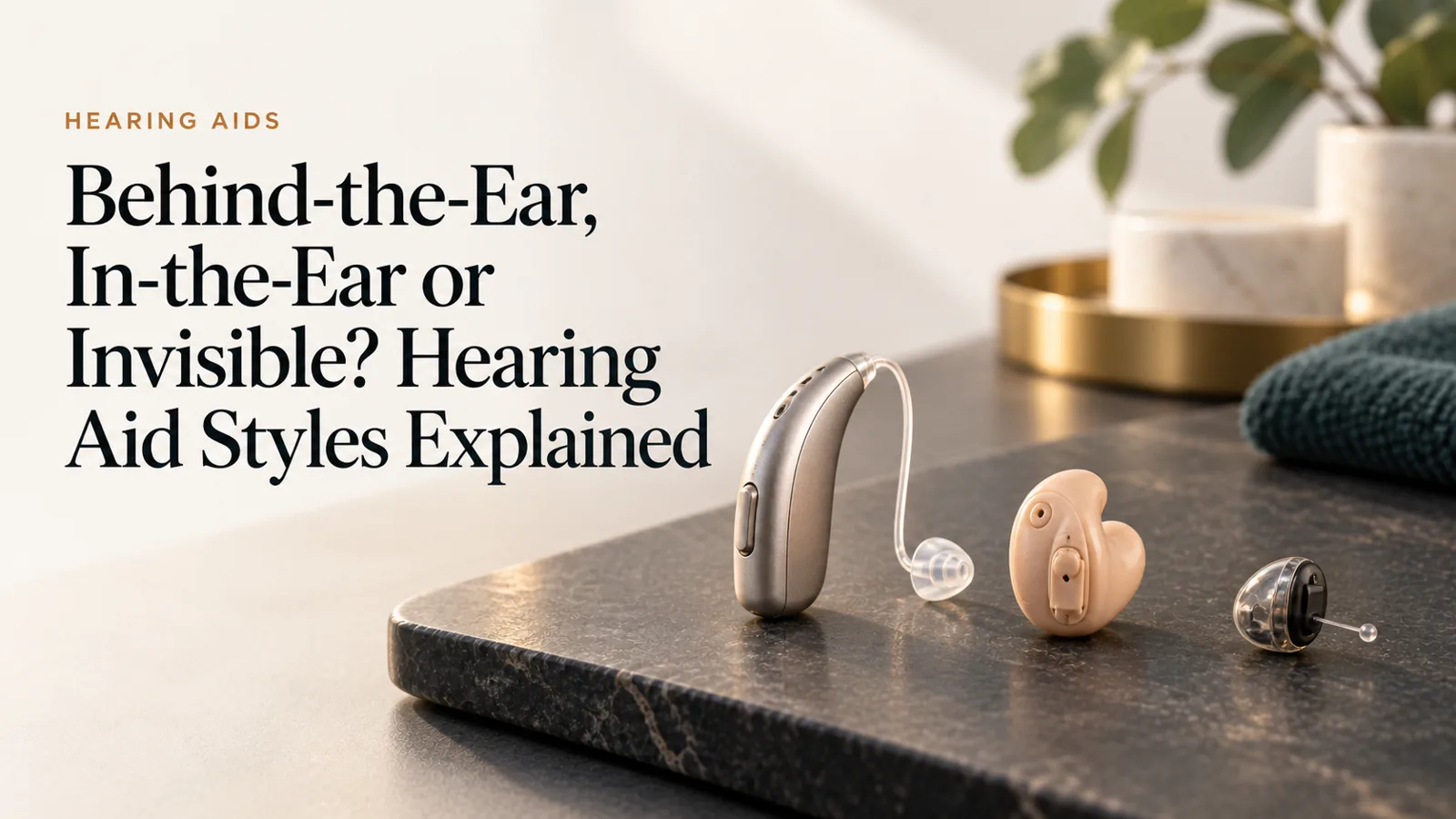
This is the classic shape most people picture. The working parts sit in a small case behind your ear, and a thin tube or wire carries sound into the ear canal. Modern behind-the-ear aids are far slimmer than the beige bananas of years gone by, and many tuck away almost completely behind the ear.
A close cousin is the receiver-in-canal (RIC) aid, where the tiny speaker sits in the ear itself on the end of a slim wire. It's one of the most popular styles fitted today because it's discreet, comfortable and open-sounding.
Behind-the-ear styles tend to suit:
- A wide range of hearing losses, from mild right through to more significant.
- People who want rechargeable aids, as the larger case holds a bigger battery.
- Anyone who finds very small aids awkward to handle.
What about in-the-ear styles?
In-the-ear (ITE) and in-the-canal (ITC) aids are custom-made from an impression of your ear, so they fit like a key in a lock. Everything sits in one moulded piece in the outer ear or canal, with no part behind the ear at all.
Many people like that. There's nothing to clash with glasses or a face covering, and the controls sit on a faceplate you can reach easily. The trade-off is that the working parts sit closer to wax and moisture, so they benefit from regular cleaning and the occasional professional check. Keeping your ears clear with routine microsuction wax removal also helps them perform at their best.
These styles often suit mild to moderate losses and people who'd rather nothing sat behind the ear.
Are "invisible" hearing aids really invisible?
Completely-in-canal (CIC) and invisible-in-canal (IIC) aids sit deep in the ear canal, and on many people little or nothing shows. They can be a lovely, natural-sounding option, and the discretion genuinely matters to some.
We'd rather be honest about the limits, though. Because they're so small:
- They can't hold the power needed for more significant hearing loss.
- The batteries are tiny and don't last as long between changes.
- They can be fiddly to insert and clean if your dexterity or eyesight is limited.
- Sitting deep in the canal, they meet more wax and moisture, so upkeep matters.
For the right ear and the right loss, they're excellent. For others, a slim behind-the-ear aid is actually more discreet in practice than a struggle with something that keeps blocking up.
How do I choose, and do brands matter?
We're independent, so we fit all seven leading manufacturers — Widex, Phonak, Signia, Starkey, Oticon, ReSound and Unitron — with no bias towards any of them. That matters here because not every brand makes every style in every power level, and some do a particular shape especially well. Being able to choose freely means we match the aid to you, rather than squeezing you into whatever's on the shelf.
Most styles now offer Bluetooth streaming to a phone or television, so wanting that rarely forces your hand. The honest answer to "which style is best?" is that it depends on the four things at the top of this article, and the only way to know is to try. At a consultation we can show you the options, let you hold them, and talk through what fits your ears and your life. Not sure what to expect? Here's a walk-through of your first visit.
Ready to see which style suits you? Book a hearing-aid consultation with our family-run team in Wickersley, or call us on 01709 437250 for a friendly chat first.