

Ear wax gets a bad name it does not deserve. It is not dirt. It is your ear's own way of trapping dust, keeping the canal from drying out and slowing down bacteria, and for most people it clears itself without any help at all. The trouble usually starts when we decide to speed things along. Walk into any chemist and you will find candles, sprays, drops, scoops and little suction gadgets, all promising a clear ear. Some are harmless, some are genuinely useful, and a few can do real damage.
Here is an honest look at what belongs in an adult ear, what does not, and when it is worth seeing someone.
Do ear candles actually work?
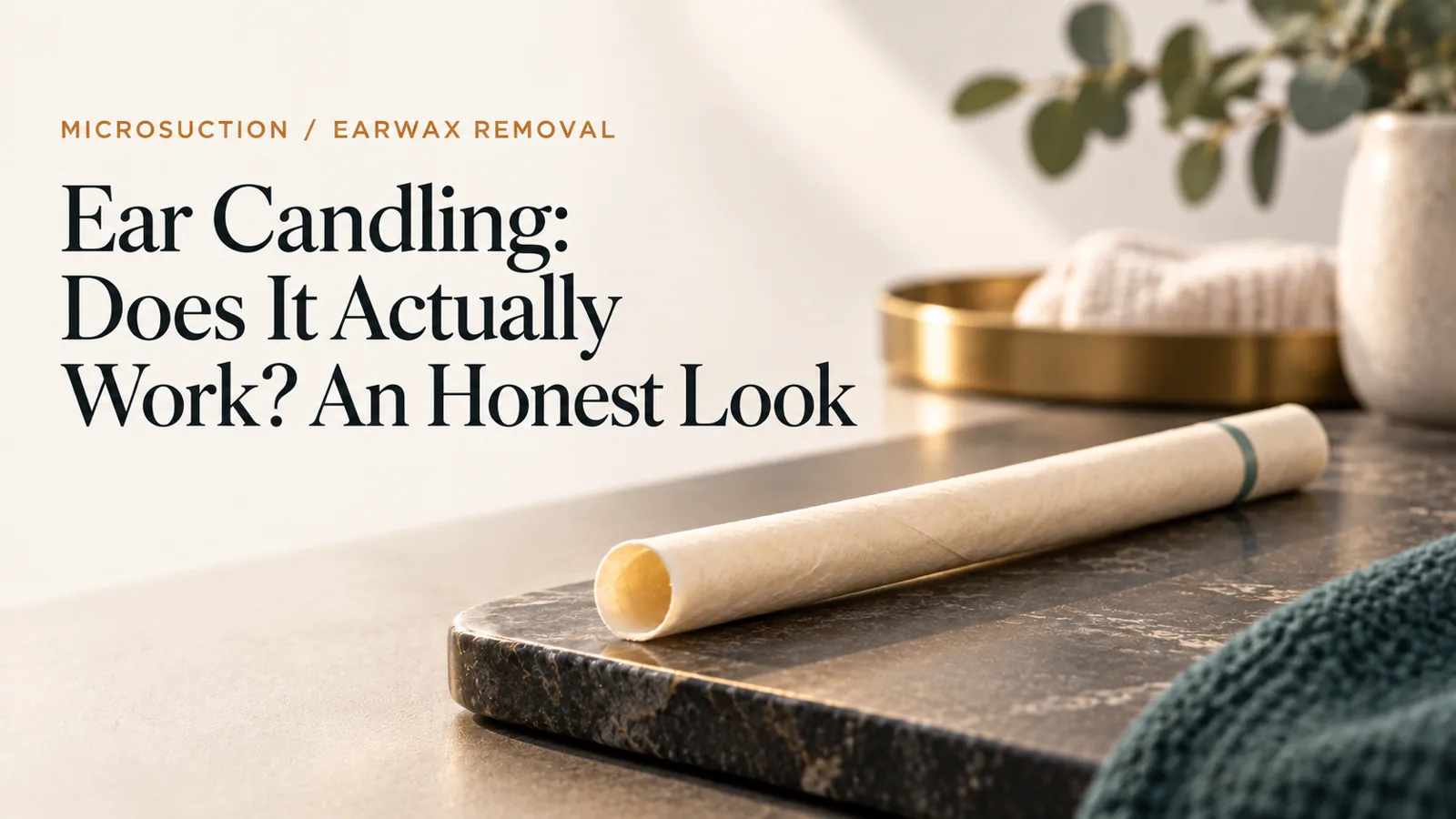
In a word, no. Ear candling, sometimes sold as "thermo-auricular therapy", involves placing a hollow, cone-shaped candle in the ear and lighting the far end, on the idea that the warmth creates a gentle vacuum that draws wax out. The problem is that it does not create any meaningful suction, and the brown residue left inside the candle afterwards is candle wax and ash, not ear wax. Studies and regulators on both sides of the Atlantic have found no benefit whatsoever.
The risks, on the other hand, are real: burns to the face, ear and hair, and hot candle wax dripping into the canal, where it can stick to the eardrum or block the ear completely. Our firm advice is to give ear candles a miss.
Are ear drops safe to use at home?
Often, yes, and they are usually the sensible first step. Plain olive oil or almond oil drops, warmed to room temperature, soften hardened wax over a week or two so that it can work its way out naturally. Sodium bicarbonate drops from the pharmacy do a similar job. This is the same softening the NHS suggests before any professional removal.
A few sensible cautions:
- Do not use drops if you have ear pain, any discharge, or think you might have a burst (perforated) eardrum or an infection. Get that looked at first.
- Avoid almond oil if you have a nut allergy.
- Stronger over-the-counter drops that fizz (the urea-hydrogen peroxide type) can work, but they irritate some ears. Stop if it stings.
Drops alone will not shift a canal that is completely blocked, but they make everything easier and sometimes solve the problem on their own.
What about cotton buds, picks and DIY suction kits?
This is where most of the harm happens. Cotton buds feel satisfying, but they push more wax deeper than they remove, packing it hard against the eardrum. The old advice still holds: put nothing smaller than your elbow in your ear. Metal or plastic ear picks and spiral "scoops" are worse again, easily scratching the delicate canal skin or nicking the eardrum, which invites infection.
The battery-powered ear vacuums and DIY suction kits sold online sound clever but are generally far too weak to move real wax, and the little camera "removal" tools simply tempt people to dig where they cannot see. Flushing at home with a bulb syringe is risky too, particularly if there is any chance of a perforation. As a rule, if a gadget is designed to go down the ear canal, be very wary of it.
When should you leave your ears well alone?
Most of the time, the answer is to do nothing. Healthy ears clean themselves, and chasing wax that is not causing any trouble only stirs things up. It is worth getting seen when you notice a blocked or muffled feeling that will not clear, dulled hearing, earache, ringing, or a full sensation after water gets in. If your only symptom is ringing or buzzing with no wax and no change in your hearing, that is one for your GP or the NHS in the first instance, and the British Tinnitus Association has calm, reliable information while you wait. If you would like to check where things stand first, our free online hearing check takes a couple of minutes and gives you a sensible steer.
How do we remove wax safely?
When wax does need to come out, we use microsuction, not syringing. It uses a gentle medical suction and a bright microscope so the audiologist can see exactly what they are doing throughout, with no water flushed into the ear. It is quick, tidy and suitable for most people, including those with a history of perforations or ear surgery. If you are not sure what a visit involves, our page on what to expect walks you through it.
If your ears feel blocked or you simply want peace of mind, we are glad to help. You can book a microsuction wax-removal appointment online, or call the clinic on 01709 437250 and we will find you a time.