

Hearing aids have quietly become some of the cleverest little computers most people will ever wear. If your current pair is a few years old, or you are only just thinking about your first set, you may have heard talk of "Bluetooth hearing aids" and a newer word, "Auracast". Both come up a lot in our Wickersley clinic, usually with a fair bit of confusion attached.
So here is a plain, no-jargon guide to what these features really do, where they are genuinely useful, and whether any of it should change what you buy.
What does Bluetooth actually do in a hearing aid?
Bluetooth is the same wireless technology that connects your phone to a car stereo or a wireless speaker. In a modern hearing aid, it lets sound travel straight from a device into your ears without a cable.
In practice, that means:
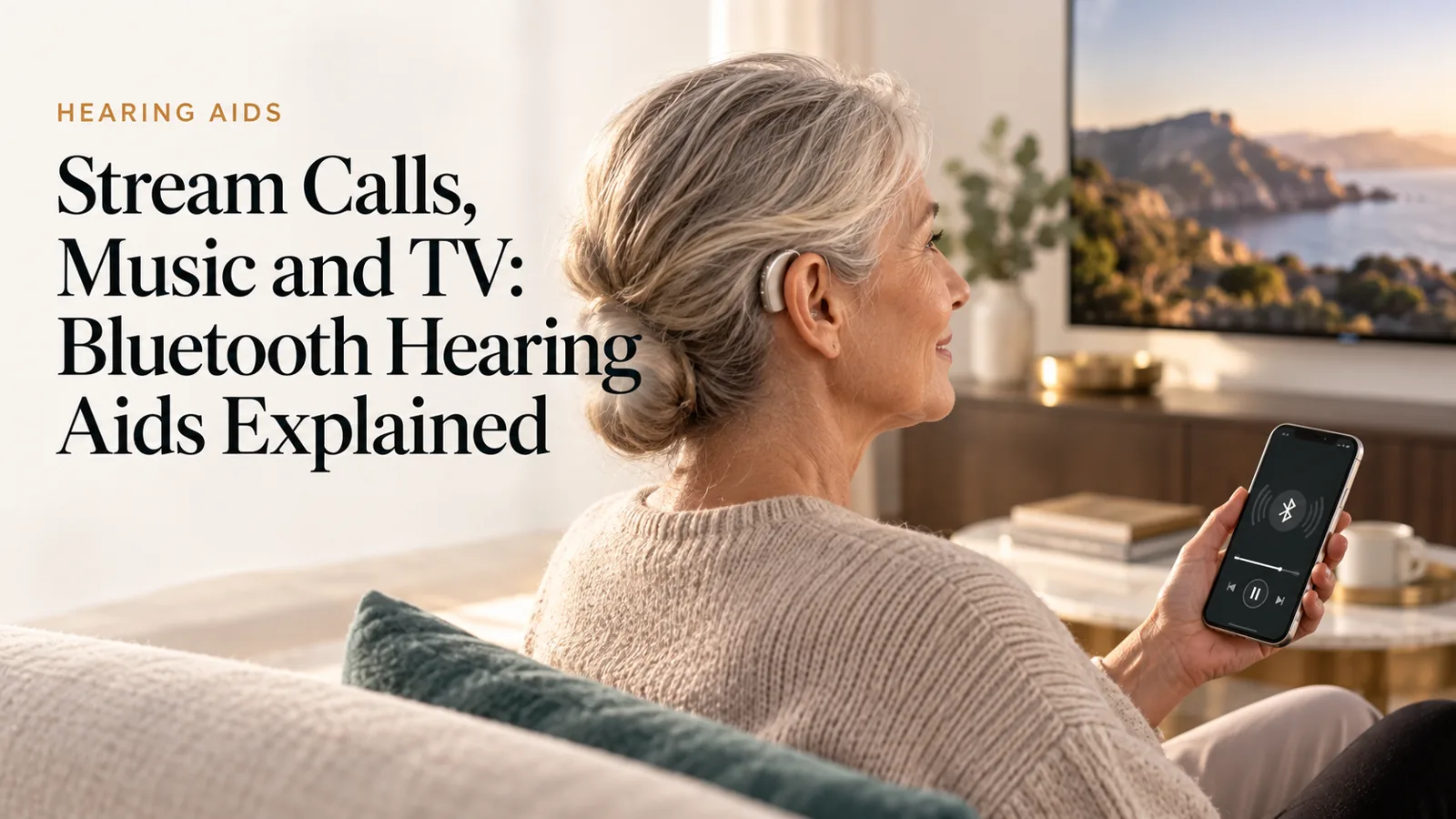
- Phone calls come through both hearing aids at once, so a caller's voice is clearer and you are not holding a handset to one ear.
- Music, podcasts and the radio stream directly, turning your hearing aids into a discreet set of earphones.
- The television can be sent to your ears at your own volume, while everyone else keeps the room at a level that suits them.
- A phone app often acts as a remote control, so you can nudge the volume or switch settings without touching your ears in public.
Most of the hearing aids we fit now offer some form of Bluetooth streaming, though the detail varies between brands and between Apple and Android phones. It is one of the things worth talking through when you choose a pair, and we cover the options properly on our hearing aids page.
What is Auracast, and why is everyone talking about it?
Auracast is a newer feature built on the latest version of Bluetooth. The simplest way to picture it is this: instead of one device pairing with one set of hearing aids, a single transmitter can broadcast sound to any number of listeners at once, a bit like tuning a radio to a station.
Imagine sitting in a waiting room where announcements are being drowned out by background noise, and being able to "tune in" to that audio straight through your hearing aids. Or a cinema, a theatre, a church or a railway station sending its sound directly to your ears, clear and steady, with none of the echo and clatter of the room.
If that sounds familiar, it is because it does a similar job to the old induction loop, the "T" setting many people already use at bank counters and ticket offices. Auracast is essentially the modern successor: better sound, and not limited to places that have gone to the trouble of installing a physical loop.
Where can you actually use Auracast today?
This is where honesty matters. Auracast is real and it is arriving, but it is still early days. Through 2026 we are starting to see it appear in the UK, in some cinemas, at certain rail stations, and in a slowly growing list of public venues, and the pace is picking up. But it is not yet something you will find on every high street in Rotherham.
So it is best thought of as a feature that will become more useful over the next few years, rather than something that transforms daily life the moment you switch it on. For streaming your own phone and TV, the benefits are here right now. For broadcasting in public places, the world is still catching up to the technology.
Do you need to rush out and upgrade?
Almost certainly not, and we would rather tell you that plainly than sell you something you don't need. A hearing aid that fits your hearing loss well and sits comfortably will always matter more than the newest wireless trick. Good hearing comes first; connectivity is a welcome extra.
A few honest pointers:
- If your current aids are working well and you are happy with them, there is no need to replace them just to chase Auracast.
- If you are due an upgrade anyway, or buying for the first time, it is sensible to ask what a pair supports so you are ready as more venues switch it on.
- Some newer hearing aids can gain features through a software update, so "ready for the future" does not always mean buying the most expensive model in the range.
Because we are independent and fit all seven leading brands, we have no reason to steer you towards one make over another. We can simply match the right technology to your ears, your phone and how you actually live.
How do you know if your hearing aids are ready?
The easiest answer is to ask us. Whether your hearing aids support Bluetooth streaming, and whether they are built on the newer standard that Auracast uses, depends on the model and how recently it was made. If you are not sure where you stand, bring them in and we will check for you.
And if you have not had your hearing looked at in a while, that is the more important starting point. Our free online online hearing check is a gentle first step you can do at home, and if it flags anything, a proper appointment tells you far more. You can see exactly what to expect when you book a free hearing test with us.
Curious whether Bluetooth or Auracast could make a real difference for you? Pop in for a chat, book a hearing-aid consultation, or give us a call on 01709 437250 and we will talk it through, no pressure.