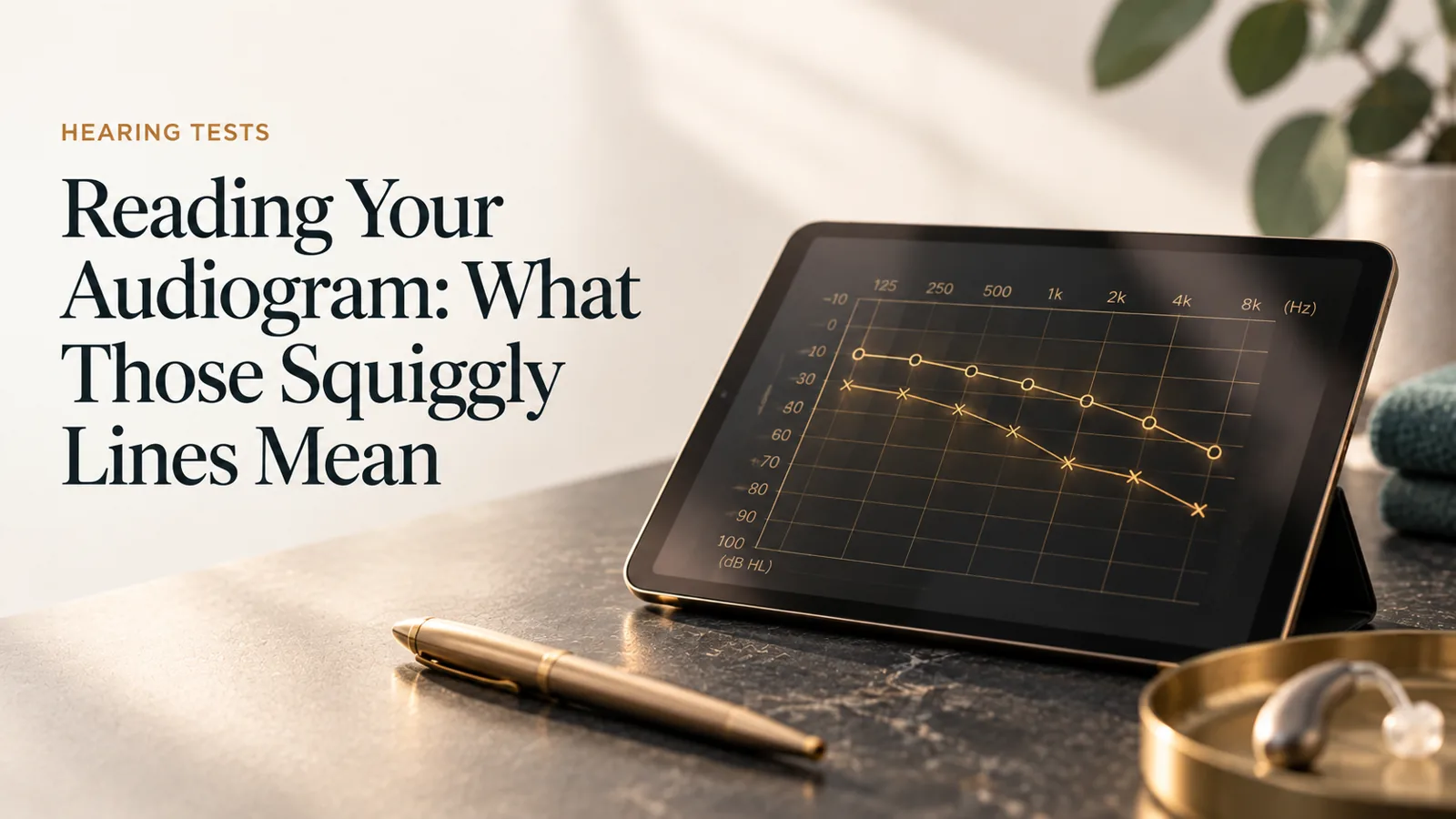


If you have recently had your hearing checked, you may have come away with a chart covered in symbols, lines and numbers and not much idea what any of it means. That chart is called an audiogram, and it is one of the most useful pictures of your hearing you will ever see.
The good news is that once someone shows you how to read it, an audiogram is surprisingly straightforward. Here is a plain-English guide to what those squiggly lines are actually telling you.
What is an audiogram?
An audiogram is simply a graph of your hearing. During a online hearing check you listen through headphones to a series of beeps at different pitches and volumes, and you respond each time you hear one. We plot the quietest sound you can detect at each pitch, and joining those points gives us the lines on your audiogram, one for each ear.
It is not a test you can pass or fail. It is a snapshot of how your ears are working today, and a baseline we can compare against in years to come.
What do the two axes mean?
The chart has two directions, and each tells you something different.
- Left to right is pitch (frequency), measured in Hertz (Hz). Low, rumbly sounds like a deep voice or a bass note sit on the left. High sounds like a bird, a doorbell or the letters "s" and "th" sit on the right.
- Top to bottom is loudness, measured in decibels (dB). Quiet sounds are near the top of the chart; loud sounds are near the bottom.
Here is the key point. The further down the chart your marks sit, the louder a sound has to be before you notice it. Marks near the top mean you pick up quiet sounds easily. Marks lower down mean that pitch has to be turned up before it reaches you.
What do the colours and symbols mean?
You will usually see two sets of marks. By convention the right ear is marked with a circle (O), often in red, and the left ear with a cross (X), often in blue. The old memory aid is simply "right is red".
You may also spot a second type of symbol, sometimes a bracket or an arrow. That is because we test your hearing in two ways:
- Air conduction sends sound through headphones and down the ear canal, the normal route. This checks the whole hearing system from start to finish.
- Bone conduction uses a small padded vibrator resting behind the ear to send sound straight to the inner ear, bypassing the ear canal and eardrum.
Comparing the two tells us where any hearing loss is coming from, which matters a great deal for what happens next.
How do I know if I have hearing loss, and how much?
Audiologists group results into broad bands based on how far down the chart your quietest audible sounds fall. In general terms, marks near the top reflect normal hearing, and as they move downward the loss is described as mild, moderate, severe or profound. These are clinical labels, not judgements, and plenty of people with a "mild" loss on paper still find it genuinely affects conversations in noisy places.
You may also find your two ears differ, or that one part of the chart looks fine while another dips. That is common and often very telling. If you would like a fuller explanation of the different types and degrees, our page on hearing loss goes into more detail.
What does the shape of my audiogram tell me?
The shape often matters more than any single number.
- A line that slopes downward from left to right is the most common pattern we see in adults. It means the low pitches are fine but the high ones have faded, which is typical of age-related and noise-related hearing loss. This is why so many people say they can hear that someone is talking but cannot quite make out the words. The high-pitched consonants that carry clarity are the first to go.
- A gap between the air and bone conduction lines suggests something in the outer or middle ear is blocking sound, such as earwax or fluid. This kind of loss is sometimes reversible. If wax is the culprit, gentle microsuction wax removal may be all that is needed.
- A dip at one particular pitch, often in the higher frequencies, can point to past noise exposure from machinery, music or shooting.
What happens after we read it together?
An audiogram is only half the story. The most valuable part of your appointment is sitting down with an audiologist who explains what your particular chart means for your life, your work and the conversations you most want to hear. Numbers on a page cannot tell us whether you are struggling at the dinner table or in meetings. A proper conversation does that.
If you are wondering what an appointment actually involves, our guide to your first visit walks you through it step by step. As an independent, HCPC-registered clinic we fit hearing aids from all seven leading manufacturers, so any advice we give is based on your results and your needs, not on any one brand.
And sometimes the honest answer is that you do not need us yet. If that is the case, we will happily tell you so.
Curious what your own audiogram would show? Book a free hearing test at our Wickersley clinic, or call us on 01709 437250, and we will talk you through every line together.