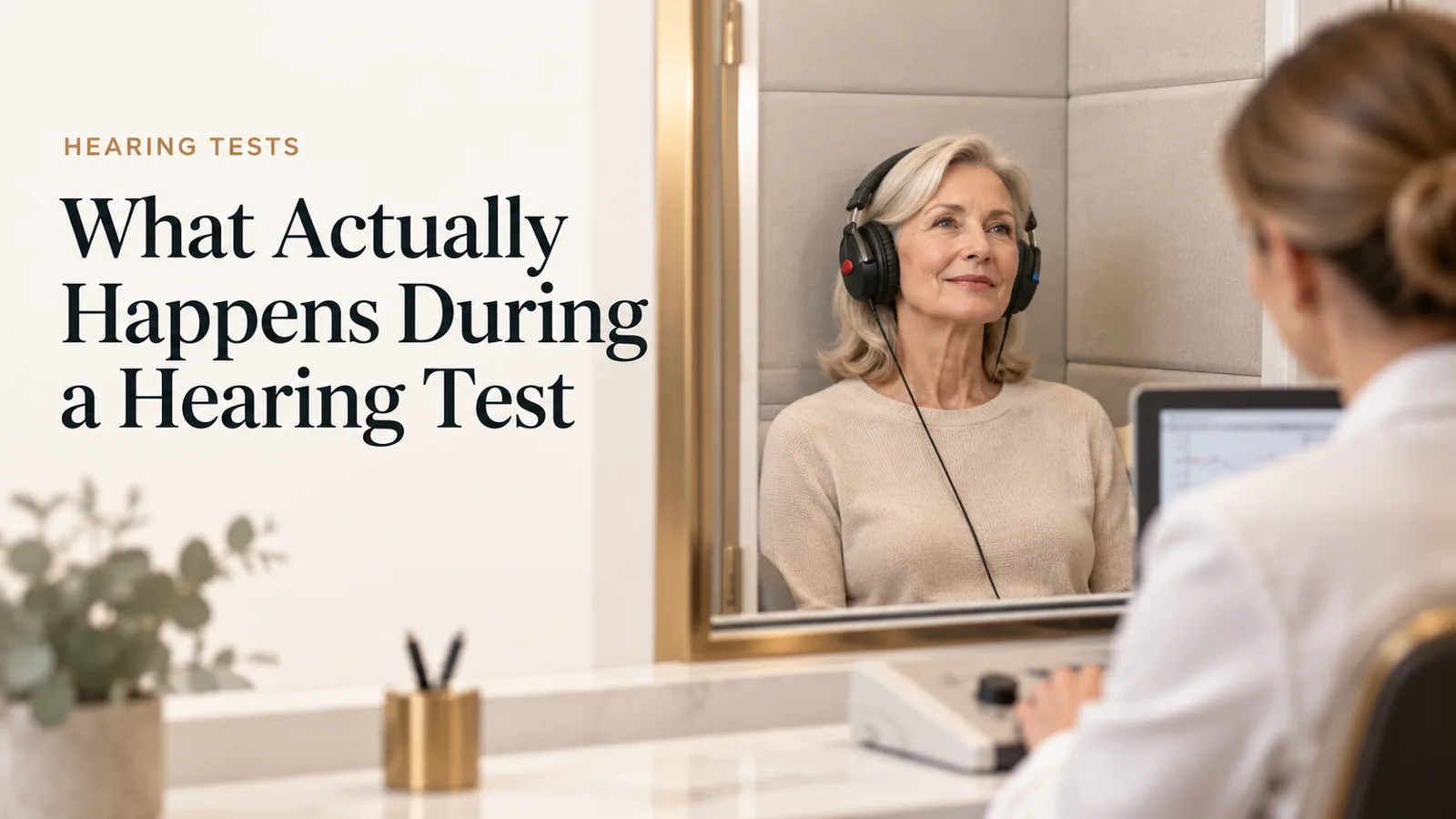


Most people picture a hearing test as sitting in a quiet booth, wearing headphones, and pressing a button every time they hear a faint beep. That part is real, and it matters. But it is only one piece of what happens when you come in for an assessment.
A good hearing test is really about building a picture of how you hear in everyday life, not just whether you can detect a tone in a silent room. Here is what we are actually checking, and why each part earns its place.
Does it really start with the beeps?
No. Before any headphones go on, we sit down and talk, and this is the part people tend to underestimate. We will ask when you first noticed a change, which situations you find hardest (a busy pub, the television, one person versus a group), whether one ear seems worse than the other, and whether you have had any ringing, dizziness or pain.
We also ask about your general health, any medication, and whether you have worked or spent time around loud noise over the years. None of this is box-ticking. Where your difficulty shows up in real life often tells us more than the numbers alone, and it shapes everything that follows. If you would like a sense of where you stand before you book, our free online hearing check is a quick, no-pressure starting point.
Why do we look inside your ears first?
Next we look inside each ear with a small light, which we call otoscopy. We are checking the ear canal and the eardrum, and one of the most common things we find is simply wax. A canal blocked with wax can make your hearing worse and can throw off the rest of the test, so it needs dealing with first.
If wax is the culprit, we clear it gently by microsuction, which uses fine suction under a microscope rather than water. Now and then that alone sorts the problem out and nothing more is needed. It is a good example of why we never jump straight to hearing aids.
What are the beeps actually telling us?
Now the headphones. The beeps (pure tone audiometry) map the quietest sounds you can hear across a range of pitches, from low to high. We plot the results on a chart called an audiogram, and it usually shows a pattern rather than a flat line. Age-related loss, for example, tends to affect the higher pitches first, which is why speech can sound present but not clear.
We also test with a small vibrating pad placed behind the ear (bone conduction). Comparing the two results tells us where the loss sits. If sound is getting stuck on its way into the ear, that points to the outer or middle ear, which is often treatable. If the inner ear is where the difficulty lies, that tends to be the more permanent, age-related kind of hearing loss. Knowing which one you have changes what we recommend, so it is not a detail we skip over.
Why test how you hear speech, not just tones?
Hearing a beep in silence is not the same as following a conversation when there is noise in the background. That noisy situation is the one most people actually struggle with. So we look at how clearly you understand speech, not only how quietly you can detect a tone.
This is where two people with almost identical audiograms can have very different day-to-day experiences. It also helps us set honest expectations. Hearing aids are very good at making speech clearer, but they are not a switch that returns your hearing to how it was at twenty, and we would rather tell you that plainly than oversell.
What happens once the test is done?
At the end we go through what we have found together, in plain terms, with the audiogram in front of you. Sometimes the honest answer is that your hearing is fine for now and a repeat check in a year or two is all you need. Sometimes it is wax, dealt with there and then. And sometimes it is a hearing loss worth doing something about.
If aids would genuinely help, we will talk through the options without any pressure. As an independent, family-run clinic we fit all seven leading brands, so any recommendation is based on your hearing and your life, not on meeting a sales target. There is also a growing reason not to put it off: research increasingly links untreated hearing loss with a higher risk of cognitive decline as we get older, so acting sooner tends to be the kinder choice in the long run.
None of it is uncomfortable, and nothing is rushed. If you would like to know exactly how the appointment runs from start to finish, our guide to what to expect at your first visit walks you through it.
Whenever you are ready, you can book a free hearing test or call us on 01709 437250, and we will take it from there.